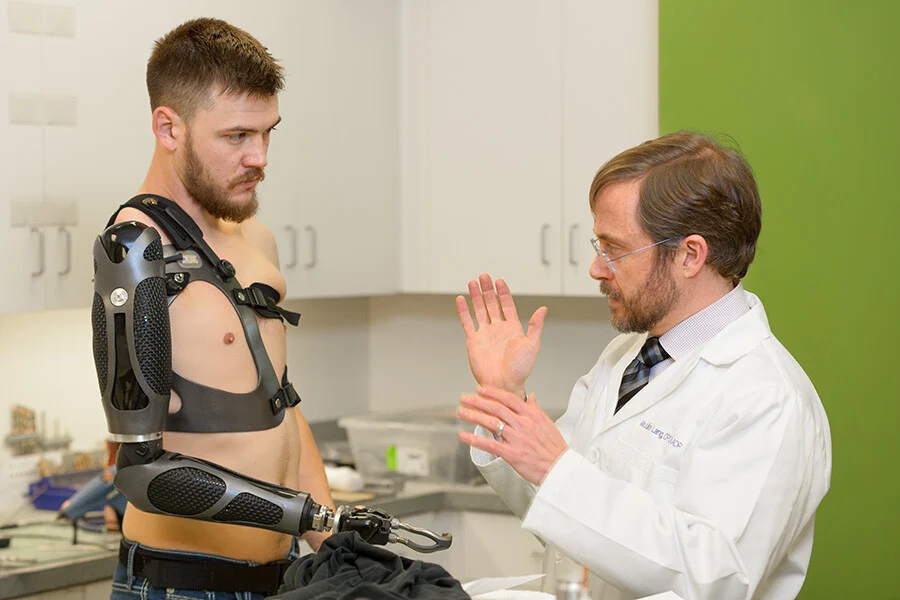
Introduction

Imagine a world where a prosthetic arm isn’t just a replacement — it elevates your strength, reacts faster than your natural reflexes, and feels like an extension of you. Welcome to the frontier of prosthetic arms that are truly supercharged.
Prosthetic arms are no longer passive tools; they’re evolving into powerful, intelligent systems built to amplify human ability. From soft robotics to brain-computer interfaces, modern prosthetic innovations are transforming the lives of amputees — giving them strength, speed, and a new level of agency.
In this deep dive, we’ll explore 7 game-changing innovations driving the progress of prosthetic arms. We’ll break down the technology, examine real-world impact, and look ahead to where this remarkable field is going.
1. Neural Feedback & Brain-Computer Interfaces
One of the biggest breakthroughs in prosthetic arms is the integration of brain-computer interfaces (BCIs) to deliver both control and real-time sensory feedback.
- Researchers at the University of Chicago have advanced a system where tiny electrode arrays in the brain restore tactile sensations. These systems can recreate the feeling of shape and motion, helping users better sense what their prosthetic is touching. ScienceDaily
- Complementary research in Italy demonstrated that paired electrodes can build more nuanced “touch zones,” enabling a more refined perception of pressure or texture. upmc.it
Why This Matters:
- Restored sense of touch dramatically improves the usability of prosthetic arms.
- Sensory feedback reduces reliance solely on vision, which makes tasks like grasping fragile objects safer and more intuitive.
2. AI-Driven Signal Decoding and Adaptive Control
Artificial intelligence (AI) is playing a leading role in transforming prosthetic arms from reactive tools into predictive partners.
- According to a market report, the AI-powered prosthetics industry is booming — thanks to neural interfaces and systems that learn from the user’s muscle or nerve signals. GlobeNewswire
- A Texas-based neurotech startup recently announced an implantable system backed by DARPA and the FDA. This implant reads electrical signals beneath the skin and uses AI to translate them into smooth, precise movements for a prosthetic limb. prosthetics-robotics-show.com
- On the academic front, machine learning models are being used to interpret electromyography (EMG) signals, translating them into force estimates for super-precise grip control. arXiv
Key Benefits:
- Personalization: AI adapts to how a user moves over time, refining control.
- Responsiveness: Predictive systems can reduce lag, making prosthetic arms feel more “alive.”
- Efficiency: Instead of pre-programmed motions, the prosthetic can intelligently anticipate user intent.
3. Soft, Bio-Inspired Prosthetic Hands
Rigid, metal prosthetics are no longer the only game in town. Designers are now embracing soft robotics to mimic the natural dynamics of human muscles and tendons.
- A recent breakthrough described by Impact Lab involves a soft prosthetic hand that uses motoneuron signals decoded from the spinal cord. impactlab.com
- By integrating postural synergies — the coordinated way human fingers move — with neural decoding, this prosthetic can perform complex tasks more intuitively.
Why This Innovation Matters:
- Soft materials make the arm lighter, safer, and more comfortable.
- The design allows for more fluid, natural movements, improving both dexterity and speed.
- When combined with neural interfaces, it delivers highly intuitive control.
4. Targeted Reinnervation & Advanced Interfaces
Targeted reinnervation is a surgical technique that reassigns nerves to remaining muscles — enabling better signal collection for prosthetic control. Wikipedia
- In this method, residual nerves are routed into other muscles, and the EMG signal from these reinnervated muscles is then used to control a prosthetic.
- Sensory reinnervation is also possible, allowing feedback signals to be delivered to skin areas over the re-wired muscles.
Impact on Strength & Speed:
- More accurate signal input = finer control
- Stronger, more natural command over complex prosthetic movements
- Enhanced feedback loop that strengthens user-limb synergy
5. Smart Materials & Adaptive Fit
Beyond control, how a prosthetic fits can define its performance. Innovations in smart materials are helping prosthetic arms adapt in real-time for better force transmission and comfort.
- Engineers are developing adaptive sockets and materials that can adjust their stiffness or volume in response to how the user is moving or how much pressure is being applied. steelbone.co.uk
- These smart interfaces can reduce energy loss, meaning more of the user’s muscle power goes into meaningful movement — boosting strength and efficiency.
Real-World Gains:
- Better fit reduces fatigue and discomfort
- More efficient force transfer boosts lift capacity
- Users can maintain high performance throughout the day
6. Low-Cost, Accessible Prosthetics Powered by Machine Learning
Not all life-changing prosthetic arms have to come with a million-dollar price tag. Researchers are developing affordable options that still deliver advanced performance.
- A recent study introduced a low-cost myoelectric prosthetic hand using EMG and a shallow neural network. It achieved strong gesture classification accuracy and integrated tactile feedback through vibration motors. arXiv
- These approaches expand access, especially in developing regions where cost is a barrier.
Why This Matters:
- Democratizes high-tech prosthetic access
- Empowers more users with performance enhancements
- Encourages innovation and customization in resource-constrained settings
7. Emerging Market & Biometric Trends
Looking ahead, some of the most exciting developments involve combining biological materials, open-source design, and cross-disciplinary engineering.
- A recent review of neuromuscular prostheses shows how AI, deep learning, and hybrid interfaces are converging to produce more intuitive, powerful limbs. MDPI
- Open communities like E-NABLE are pushing boundaries by sharing 3D-printable prosthetic designs — making cutting-edge prosthetics accessible and customizable. Wikipedia
- In more futuristic territory, some researchers are exploring ways to use bioengineered muscle tissue to create prosthetic limbs that contract and relax more like real muscles.
Comparison Table: Innovations Driving Speed & Strength in Prosthetic Arms
| Innovation | How It Enhances Strength & Speed | Key Advantages | Challenges |
|---|---|---|---|
| Neural Feedback & BCI | Restores sense of touch, more precise control | Better object manipulation, safety | Requires surgery, complex calibration |
| AI-Driven Control | Predicts intended motions in real time | Faster, adaptive, personalized control | Needs high-quality data, risk of overfitting |
| Soft, Bio-Inspired Hands | Fluid motion, lower weight | Natural grasp, more dexterity | Durability, power source integration |
| Targeted Reinnervation | More accurate signal routing | Stronger control, sensory feedback | Invasive, requires surgical expertise |
| Smart Materials / Fit | Adapts dynamically to pressure | Better comfort, efficient power use | Material cost, durability under stress |
| Low-Cost ML Prosthetics | Accessible AI-powered functionality | Affordability, greater reach | Limited strength, simpler mechanics |
| Open-Source / Biohybrid | Combines robotics and biology | Highly customizable, futuristic | Regulatory hurdles, biocompatibility |
Real-World Impact: How These Prosthetic Arms Are Changing Lives
Restoring Natural Function
For many prosthetic users, the dream has always been to feel and move naturally. Innovations in neural feedback and brain-computer interfaces are finally making that possible. Users can pick up fragile objects, type, or even sense texture — with confidence rather than guesswork.
Enhancing Performance
Strength is no longer a limitation. AI-driven systems enable prosthetic arms to act more like powerful tools that don’t tire out easily. Smart materials transmit more force, and adaptive control helps maintain speed and grip even during complex tasks.
Democratizing Access
Affordable, machine-learning-based prosthetics open doors for people everywhere. Whether it’s in low-resource communities or among young users, these innovations make advanced performance more attainable.
Promoting Research & Collaboration
Open-source communities like E-NABLE foster collaboration. Engineers, users, and researchers share designs, refine code, and push the entire field forward.
Challenges & Ethical Considerations
- Invasiveness & Risk
- Neural interfaces often need surgery.
- Implanting electrodes or re-routing nerves can carry medical risks.
- Data Privacy
- Systems that read brain or muscle signals generate deeply personal data.
- Who owns and protects this data is a major concern.
- Cost & Inequality
- High-end AI or BCI prosthetics can be prohibitively expensive.
- Without access, some may be left behind in the “supercharged” arms race.
- Regulatory Hurdles
- Biometric and biohybrid prosthetics (especially with organic materials) challenge current medical frameworks.
- Safety standards for AI control require robust and evolving regulation.
- Long-Term Durability
- Soft robots and smart materials must last and be maintainable.
- Users may face issues with wear and tear, calibration drift, or power supply.
The Future of Prosthetic Arms: What’s Coming Next
As we look to the horizon, here are some trends and predictions for prosthetic arms over the next 5–10 years:
- Seamless Neural Integration: Implants will become less invasive and more refined, offering high-fidelity control and feedback.
- Muscle-Tissue Hybrids: Bioengineered muscle fibers could produce prosthetics that contract like real muscles, offering natural power output.
- AI Everywhere: Smarter, self-learning algorithms will adapt to each user’s unique movement style and predict their needs in real-time.
- Home-Fit Sockets: Adaptive materials and 3D-printed sockets will offer custom, real-time fit adjustments via smartphone.
- Open Innovation Boom: The open-source design movement will expand, helping people everywhere build, customize, and improve prosthetic arms at lower costs.
- Ethical Frameworks: More work will go into data protection, consent, and regulation — ensuring prosthetics remain empowering, not exploitative.
Conclusion
Prosthetic arms are no longer just replacements — they’re becoming extensions of ourselves, supercharged with strength, speed, and intelligence. From AI-powered control to soft robotic designs and neural feedback, the innovations today are truly game-changing.
But with great power comes responsibility. As these advancements accelerate, we must balance progress with ethics, accessibility, and long-term viability. The future of prosthetic arms is bright, and if we get it right, these tools won’t just restore what was lost — they’ll push human potential to new heights.
Call to Action
If you found this exploration inspiring, share this post with friends or colleagues — let them in on how prosthetic arms are transforming lives.
Want to dive deeper? Read more on our blog about neural prosthetics, bionic strength, and how technology is blurring the line between man and machine.


