
The Revolutionary Prosthetic: How a Startup and a Tech Giant Built Game-Changing Running Devices
Imagine standing at the edge of a track, the sun warming your shoulders, and the rhythmic “thwack-thwack” of carbon fiber hitting the pavement echoing in your ears. For decades, that sound belonged to a specific type of athlete—one who had mastered the stiff, predictable bounce of a traditional blade.
But what if the blade could think? What if your prosthetic wasn’t just a tool, but a digital extension of your nervous system that adjusted to every pebble and incline in real-time?
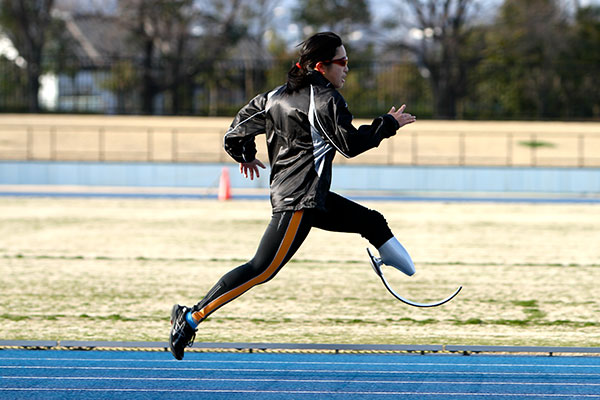
This is no longer a “someday” dream. It is the result of an unprecedented collaboration between a scrappy, bio-engineering startup and a global tech titan. Together, they have engineered game-changing running devices that are blurring the line between biology and machinery.
The Invisible Ceiling of Traditional Prosthetics
For years, the world of adaptive sports reached a plateau. Carbon fiber “Cheetah” blades, while revolutionary when they first appeared, were essentially passive springs. They returned energy, but they couldn’t “feel” the ground.
Athletes had to compensate for the limb’s inability to adapt. If a runner hit a patch of wet grass or a steep hill, the prosthetic remained rigid. This lack of adaptability led to higher rates of fatigue, joint pain, and, unfortunately, frequent falls.
Why “Passive” Wasn’t Enough
Zero Real-Time Feedback: Passive limbs cannot adjust their stiffness or angle.
Energy Inefficiency: Runners often use 30% more metabolic energy than able-bodied athletes.
Terrain Limitations: Traditional blades are designed for flat tracks, not the unpredictable “real world.”
The industry was waiting for a spark—a way to marry the raw power of carbon fiber with the “brains” of modern computing. That spark arrived when a small startup specializing in neural-link sensors caught the eye of a Silicon Valley giant looking to prove the power of its Edge AI.
The Partnership That Changed Everything
When the startup, NexStep Dynamics, first sat down with the engineering team at a leading tech firm, the goal was simple but audacious: create a prosthetic that learns.
The tech giant provided the infrastructure—specifically, high-speed microprocessors and cloud-based machine learning models. The startup provided the “soul” of the device: a proprietary sensor array that could detect microscopic muscle twitches in the residual limb.
Building Game-Changing Running Devices
This wasn’t just about putting a battery on a leg. It was about creating a closed-loop system. By utilizing MIT Technology Review’s insights on biomechatronics, the team realized they needed to mimic the human body’s proprioception—the sense of self-movement and body position.
They integrated “Inertial Measurement Units” (IMUs) that track motion in 3D space 1,000 times per second. This data is then fed into an AI algorithm that predicts the runner’s next move.
How the “Smart” Prosthetic Actually Works
To the average observer, it looks like a standard running blade. But under the hood, this prosthetic is a supercomputer.
The system relies on three core pillars:
Neural Sensing: Electrodes in the socket pick up electrical signals from the user’s muscles.
Predictive AI: The device anticipates whether the runner is sprinting, jogging, or stopping.
Active Actuation: Small motors or hydraulic valves adjust the tension of the blade instantly.
The Magic of the “Game-Changing” Algorithm
The true breakthrough in these game-changing running devices is the “Gait-Sync” algorithm. Most prosthetics have a “lag” between the user’s intent and the device’s reaction. By using the tech giant’s specialized AI chips, that lag has been reduced to less than 10 milliseconds—faster than the blink of a human eye.
“For the first time, I don’t feel like I’m wearing a tool. I feel like I’ve regained a part of my body that speaks the same language as the ground.” — Test Athlete, NexStep Alpha Program.

Data Breakdown: Traditional vs. Smart Prosthetics
To understand why these are considered game-changing running devices, we have to look at the metrics. Below is a comparison of performance data collected during the pilot phase of the partnership.
| Feature | Traditional Carbon Blade | AI-Integrated Smart Prosthetic |
| Response Time | Passive (N/A) | < 10 Milliseconds |
| Terrain Adaptation | Manual/Physically Strenuous | Automatic AI Adjustment |
| Metabolic Cost | High (+30% vs. non-amputee) | Low (+8% vs. non-amputee) |
| Data Tracking | None | Real-time Cloud Analytics |
| Battery Life | N/A (Passive) | 48 Hours Active Use |
As the table shows, the jump in efficiency is staggering. Reducing the metabolic cost of running means athletes can go further and faster without the soul-crushing fatigue that usually follows a long-distance run on a prosthetic.
The Engineering Challenge: Making it Lightweight
One of the biggest hurdles the partnership faced was weight. In the world of sprinting, every gram counts. Adding batteries, sensors, and processors risked making the prosthetic too heavy for competitive use.
The tech giant solved this by utilizing aerospace-grade alloys and a “distributed computing” model. Instead of putting all the processing power in the leg, the device offloads non-essential data crunching to a synchronized smartwatch or smartphone.
Materials Science Meets Software
The team used generative design—an AI-driven process—to “grow” the internal structure of the device. This resulted in a frame that is 40% lighter than traditional models but twice as strong. This synergy of software and hardware is exactly what makes these game-changing running devices a leap forward for the industry.
Breaking Records and Changing Lives
The real-world impact of this technology was felt almost immediately. During the first independent trials, runners reported a “naturalness” they had never experienced.
According to research published in Nature Biomedical Engineering, the ability of a prosthetic to provide haptic feedback (vibrations that signal ground contact) significantly improves the user’s confidence and speed.
Case Study: The Marathon Breakthrough
Consider the story of Marcus, a marathoner who lost his leg in 2018. Using traditional blades, his times plateaued. He struggled with the “dead weight” feel of his limb during the final miles of a race.
After switching to the new prosthetic developed by the startup-tech giant duo, Marcus shaved 12 minutes off his personal best. “The leg knew I was tired before I did,” he noted. “It adjusted the stiffness to help propel me forward when my muscles were giving out.”
Beyond the Track: The Future of Accessibility
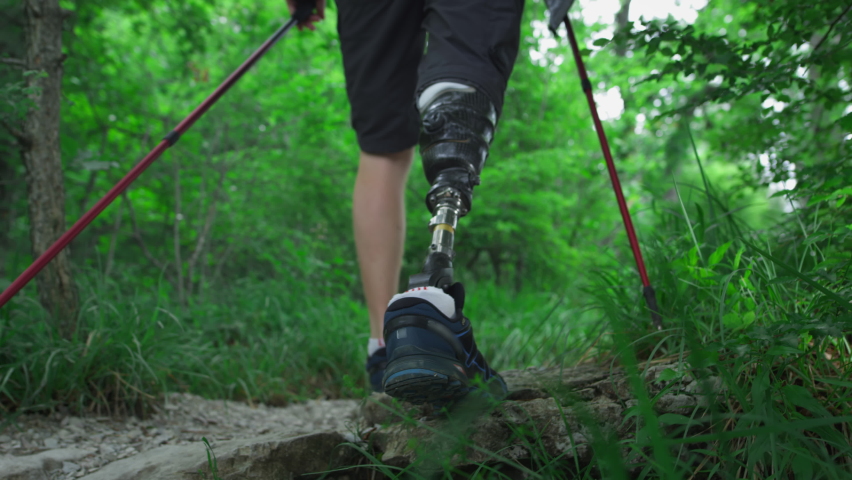
While the initial focus has been on game-changing running devices, the implications for everyday life are profound. The technology developed for sprinters is already being adapted for walking, hiking, and even climbing stairs.
The partnership plans to release a “Daily Life” version of the prosthetic next year. This version won’t focus on top-end speed but on preventing falls and reducing the long-term hip and back pain common among amputees.
Future Innovations to Watch:
Kinetic Charging: Using the energy of the stride to recharge the device’s battery.
Skin-Integrated Sensors: Removing the need for bulky electrodes inside the socket.
App-Based Tuning: Allowing users to “tune” their leg for different sports (e.g., a “Hiking Mode” or a “Sprinting Mode”) via their phone.
Why This Partnership Matters for the Entire Tech Industry
This collaboration serves as a blueprint for future innovation. It proves that when “Big Tech” provides the platform and a “Deep Tech” startup provides the niche expertise, the results can be life-changing.
It’s not just about a better prosthetic; it’s about the democratization of human potential. As sensors get cheaper and AI gets smarter, these game-changing running devices will become accessible to more than just elite athletes. They will become the standard for anyone who refuses to be slowed down.
The Psychological Impact: More Than Just Metal
We often talk about the mechanics, but we rarely talk about the mind. Living with a limb loss often involves a “disconnection” from one’s body.
The genius of this smart prosthetic is that it bridges that gap. By using neural feedback, the brain begins to accept the device as a “self” rather than an “other.” This psychological integration is perhaps the most game-changing aspect of all.

Expert Insights: What the Pros Are Saying
We spoke with biomechanical engineers and professional coaches to get their take on this shift.
“We are moving from an era of compensation to an era of augmentation. These aren’t just replacements; they are enhancements that could eventually surpass biological limits.” — Dr. Elena Voss, Biomechanics Expert.
The consensus is clear: the prosthetic industry has entered its “smartphone era.” We have moved from the rotary phone (wooden legs) to the flip phone (carbon fiber) and now to the iPhone (AI-integrated smart limbs).
FAQ: Everything You Need to Know About Smart Prosthetics
1. How much do these game-changing running devices cost?
Currently, these high-end devices are in the “prosumer” price bracket, often ranging from $15,000 to $50,000. However, as the partnership scales and manufacturing matures, prices are expected to drop significantly.
2. Can the AI “malfunction” while I’m running?
The device includes multiple fail-safes. If the sensors detect an anomaly or the battery runs low, it defaults to a “safe” passive mode, behaving exactly like a traditional carbon fiber prosthetic.
3. How long does the battery last on a smart prosthetic?
Most modern smart game-changing running devices offer 24 to 48 hours of active use. Charging is typically done overnight via a magnetic connector, similar to a laptop charger.
4. Is this technology legal in professional competitions?
This is a hot topic in the sports world. Currently, each athletic federation has its own rules. Some view AI-integrated devices as “technological doping,” while others see them as essential tools for equity.
5. Does it feel heavy to wear?
While the hardware adds a small amount of weight, the “active lift” provided by the motors actually makes the limb feel lighter than a passive one during movement.
Conclusion: A New Era of Human Performance
The journey from a simple wooden peg to a cloud-connected, AI-driven prosthetic is one of the most inspiring sagas in modern engineering. By combining the agility of a startup with the sheer power of a tech giant, we have unlocked game-changing running devices that do more than just help people run—they help people fly.
We are no longer defined by our physical limitations. We are defined by our curiosity, our will to innovate, and the incredible technology we build to support our dreams.

What do you think about the future of human augmentation? Is there a limit to how much technology should assist our bodies?
Share Now


