Introduction

Climbing changes you. For adaptive athletes — whether returning to the wall after injury, born with limb differences, or navigating a neurological condition — it can be a vehicle for physical rehabilitation, psychological resilience, and community. But to climb safely and to push limits, adaptive athletes need more than grit; they need thoughtfully engineered Adaptive Climbing Equipment.
This guide is written for adaptive athletes, coaches, and trainers in inclusive sports, sports therapists, rehabilitation specialists, assistive technology developers, inclusive sports organizations, investors in sports tech, policymakers, educators in adaptive physical education, and accessibility advocates. My aim is practical: explain core equipment, share design and training best practices, lay out procurement and scaling considerations, and point to real-world resources so you can act — whether you’re fitting a harness, designing a prosthetic terminal, running a pilot program, or writing a grant.
Why Adaptive Climbing Equipment matters for coaches, therapists, developers and policymakers
Adaptive Climbing Equipment stretches beyond a list of parts. It sits at the intersection of safety, dignity, independence and performance:
Coaches and trainers need appropriate gear understanding to design progressions that build skill without unnecessary risk.
Sports therapists and rehabilitation specialists use climbing as a therapeutic modality; the right equipment unlocks movement patterns that conventional rehab can’t replicate.
Assistive technology developers need real-world pain points so prosthetics and modular devices are adopted.
Inclusive sports organizations and investors want products that scale and demonstrate measurable outcomes.
Educators and accessibility advocates need evidence and practical guidance to implement programs.
If your role touches one of these areas, being conversant with adaptive equipment choices will help you make better programming, procurement, and funding decisions.
What this post covers
Core adaptive climbing technologies and how they work
Case examples and leaders in the space
Practical training and safety considerations for coaches and therapists
A comparison table of common adaptive climbing equipment
Design and development notes for assistive tech teams
Opportunities for investors, organizations, and policymakers
Adaptive Climbing Equipment: a quick taxonomy
Adaptive gear for climbers generally falls into these categories:
Load-bearing and safety systems — adaptive/full-body harnesses, ventral attachments, and quick-release solutions.
Mobility and propulsion aids — mechanical ascenders (hand, chest), pulley systems, and belay-assist devices.
Limb replacements and augmentations — climbing-specific prosthetics, modular terminal attachments (hooks, blades, adaptive pads).
Seated and hoist-based systems — seat harnesses and hoists for athletes with limited active limb function.
Environment and route adaptations — tactile holds, route-setting tailored for paraclimbers, and accessible gym infrastructure.
These categories overlap: a single session might use a modified harness, an ascender, and a specialized prosthetic foot.
Adaptive Climbing Equipment — essential devices explained
Adaptive Harnesses — the unsung hero
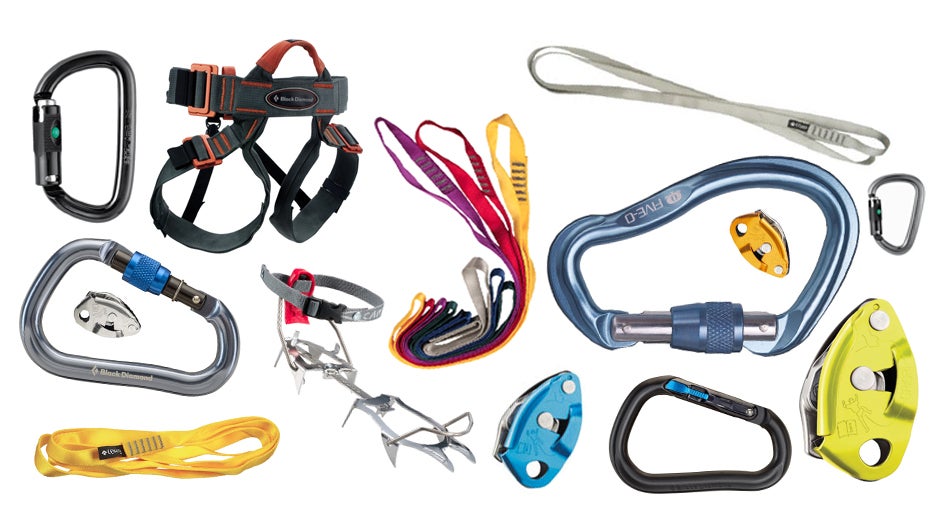
A harness designed for inclusive climbing does more than attach you to a rope. Adaptive harnesses often provide full-body support (waist + chest + integrated leg loops), extra attachment points, and modular padding. For athletes who lack core stability the harness redistributes load and reduces shear forces so climbers can focus on movement. Specialized harness makers and bespoke programs produce seat harnesses and easy-on features to support transfers and dignity during harnessing. Misty Mountain Threadworks
Ascenders and pulley systems
Hand, chest and mechanical ascenders convert pulling actions into vertical progress. One-handed cams and anti-inversion features are especially useful for climbers with limited grip or unilateral upper-limb strength. Pulley systems reduce the effective load required to move and can be combined with belay-assist devices for safer assisted ascents. Many devices originally developed for rope access and rescue have found adapted use in therapeutic and recreational climbing. PMI Rope+1
Adaptive prosthetics and terminal devices
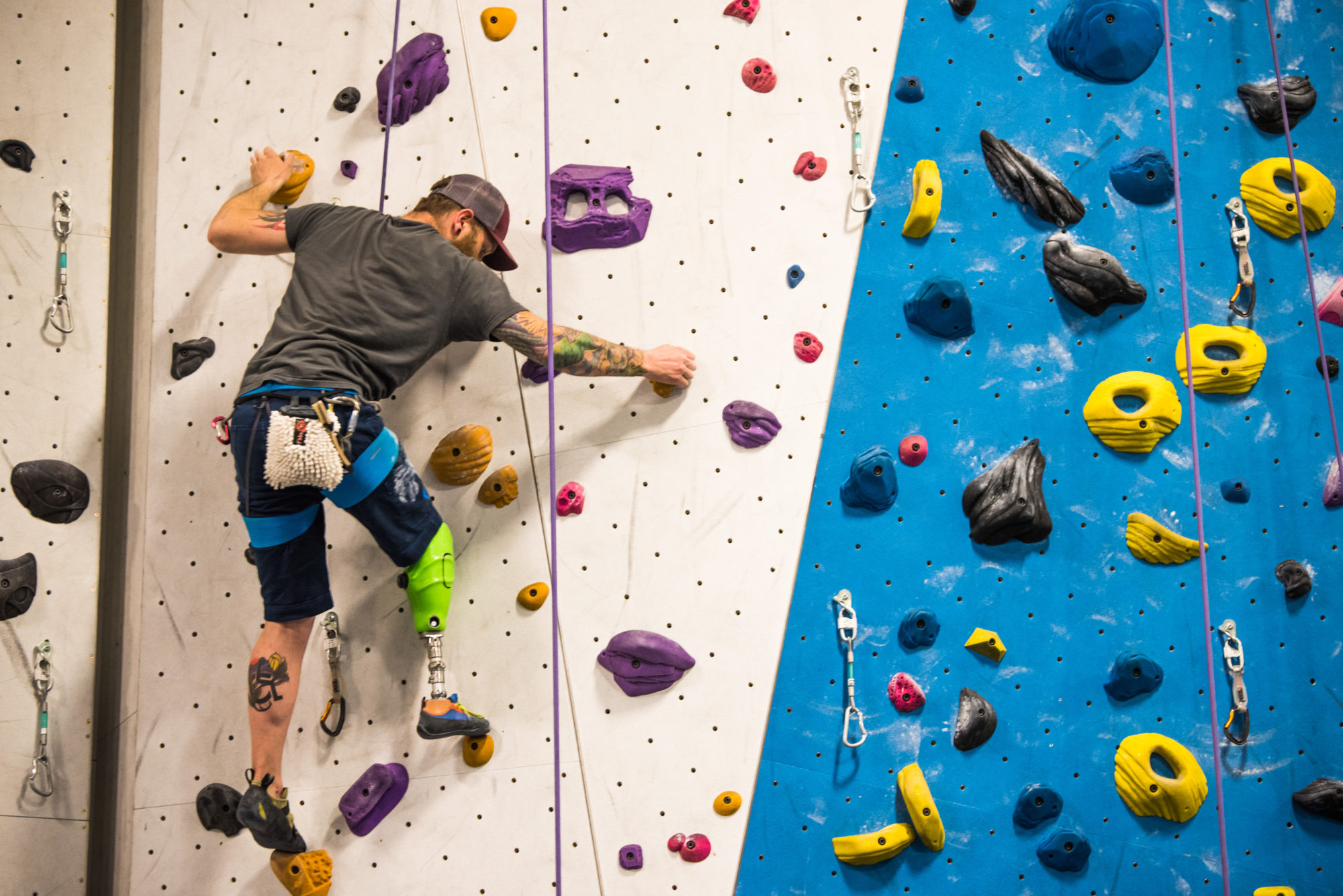
Prosthetic tech for climbing is evolving fast. Low-profile “climbing feet,” interchangeable terminal grips, and modular appendages let climbers tailor hardware to route types — edging, slabbing, overhangs, and cracks. Prosthetists increasingly collaborate with climbers to balance weight, durability, and tactile feedback so devices feel like extensions of the body rather than cumbersome tools. Alta Climbing and Fitness+1
Seated and assisted climbing setups
For athletes with very limited limb function, seat harnesses plus hoists or winch systems permit active participation in route-reading, upper-body movement, and problem solving while the system handles vertical progression. These are common in adaptive adventure programs and clinical settings where therapeutic goals — social engagement, confidence, and movement practice — are prioritized alongside safety. Programs such as Adaptive Adventures are good models for integrating equipment with trained staff and programmatic protocols. Adaptive Adventures |
Adaptive Climbing Equipment — what coaches and therapists need to know
Practical assessment checklist
Before fitting equipment, run a short functional assessment:
Postural stability and sitting balance
Grip strength and hand function
Active range of motion in shoulders, hips and knees
Spasticity or involuntary movement patterns
Cognitive or sensory factors affecting following of route instructions
These inputs determine harness choice, whether a chest vs full-body system is needed, and whether ascenders or seated systems are appropriate.
Safety first
Adaptive climbing still obeys gravity. Anchors must be solid, belay devices must match athlete mass and characteristics, and redundancy is non-negotiable. Standardize transfer procedures to prevent harnessing slips and use multiple trained belayers or mechanical belay systems for assisted climbs. Routesetters should collaborate with paraclimbers to create fair, challenging problems tailored to athlete strengths and adaptive gear. Climbing Business Journal+1
Programming and progression
Separate skill-learning from strength adaptation. Start with static holds and mirrored movements to teach technique without high fall risk. Integrate cross-training (core, antagonist muscles), proprioceptive drills, and mental rehearsal. Success for many adaptive climbers is measured in small, repeatable gains — more than sudden breakthroughs — especially around gear transitions and self-management skills.
Table: Comparison of common Adaptive Climbing Equipment
| Equipment | Best for | Pros | Cons | Typical cost range | Example brands/examples |
|---|---|---|---|---|---|
| Adaptive full-body harness | Athletes with low core stability or balance | Distributes load, safer transfers, multiple attachment points | Heavier, requires correct fitting and sizing | $80–$600 | Misty Mountain Easy Seat; Climbing Technology full-body models. Misty Mountain Threadworks+1 |
| Hand / Chest ascender | Climbers with limited lower-limb function or unilateral upper strength | One-handed operation, compact | Can abrade ropes if misused; learning curve | $50–$200 | Climbing Technology Simple Ascender variants. PMI Rope |
| Climbing-specific prosthetic foot | Amputee climbers for edging and dynamic moves | Improved edge contact, custom fit | Cost (custom prosthetics), need for multiple terminals | $300–$3,000+ | Custom prosthetics from local labs; evolving low-volume feet designs. appliedtechnology.humber.ca |
| Seat harness + hoist system | Athletes with minimal limb function | High participation, therapeutic engagement | Requires trained hoist operators and redundancy | $500–$5,000 (system) | Programmatic setups (Adaptive Adventures models). Adaptive Adventures | |
| Tactile / high-contrast holds & routes | Visually impaired climbers | Improves route-reading, inclusivity | Requires routesetting adjustments | Variable | Gym retrofit & bespoke hold sets. Paraclimbing News |
Note: price ranges are indicative and will vary by region, supplier, and whether gear is custom or off-the-shelf.
Adaptive Climbing Equipment — design principles for developers
Design for dignity and independence
Designs that feel like standard climbing gear (simple straps, intuitive buckles) reduce stigma. Prioritize quick-release systems that work with limited dexterity and modular components that athletes can swap independently.
Lightweight and durable
Use materials like high strength aluminum, composite connectors, and Dyneema webbing to lower bulk without compromising safety. Weight at the extremities matters: heavy terminal devices or bulky harness padding change how a climber moves and can create compensations.
Feedback loops and co-design
Co-design is essential. Invite athletes into early prototyping sessions and test in real-route conditions. Lab metrics (force curves, material fatigue) are useful — but a product only gets adopted if it respects transfer, comfort and real-world maintenance needs.
Regulation and competition considerations
Products intended for competition must align with classification and equipment rules. The IFSC provides classification and paraclimbing standards that impact whether certain devices are allowed in competition contexts — check those rules early in product development. IFSC Climbing+1
Sensors, data and “smart” gear
We’re beginning to see sensors embedded in prosthetics, harnesses and holds — accelerometers, force sensors and wireless telemetry that help coaches measure load, asymmetries, and time-on-hold. For developers, prioritize privacy, battery life, ruggedness, and clear feedback loops that coaches can action without drowning athletes in raw data.
Training tips for extreme adaptive athletes using Adaptive Climbing Equipment
Warm-up and mobility
Because compensations can induce overuse injuries, targeted warm-ups (shoulders, hips, ankles), dynamic scapular activation, and breathing control drills are non-negotiable.
Technique over brute force
Climbing is problem solving. With adaptive equipment, efficient body positioning reduces dependence on assistance. Video analysis and slow-motion playback are powerful tools for spotting inefficient pulls, hip rotations, or braking patterns.
Cross-training and injury prevention
Emphasize scapular endurance, rotator cuff stability, core conditioning and antagonist muscle work for wrists and elbows. For athletes using ascenders or seated rigs, monitor for pressure points and tissue tolerance under straps — frequent checks by clinicians prevent skin breakdown. ResearchGate
Procurement, scaling programs and funding for adaptive climbing
How gyms and organizations can approach procurement
Start with a needs assessment: who will use the gear, how often, and under what supervision? A modular approach often works best: a small stock of adaptive harnesses, a set of ascenders, a portable seated rig and a toolkit for prosthetic adjustment. Partner with local prosthetists and adaptive program providers for referrals and maintenance.
Funding and grants
Adaptive programs typically combine municipal recreation budgets, disability grants, corporate sponsorship, and philanthropy. Document outcomes — physical gains, attendance and qualitative testimonials — to compile compelling funding proposals. Investors should look for products with repeatable manufacturing, IP, and clinical or competitive adoption pathways.
Policy and inclusion — why standardization matters
Standardized classification systems and equipment guidance create clear certification pathways and reduce ambiguity for competition and procurement. Policymakers can accelerate inclusion by subsidizing equipment loans, training staff, and incentivizing facilities to incorporate adaptive climbing in municipal recreation systems. Cloudinary+1
Stories and real-world impact
Nothing persuades policymakers and investors like stories. Athletes using Adaptive Climbing Equipment often report meaningful psychological gains: increased self-efficacy, social connection, and willingness to try new challenges. Organizations such as Adaptive Adventures demonstrate a replicable program model combining equipment, trained staff, and scalable safety protocols — showing the direct link between gear investment and inclusive participation. Adaptive Adventures |+1
FAQs — Adaptive Climbing Equipment
Q: Is adaptive climbing safe?
A: Yes, when programs use certified equipment, trained staff, redundancy in anchors, and standardized transfer procedures.
Q: Can I use commercial climbing gear for adaptive climbs?
A: Many ascenders, carabiners and standard harnesses are used successfully — but individual fit and function must be verified by a qualified practitioner and, when needed, adapted.
Q: How expensive is adaptive climbing equipment?
A: Costs vary widely: simple ascenders can be under $100; custom prosthetics may run into thousands. Many community programs offset costs via equipment loans, grants, and partnerships.
Next steps for stakeholders
For athletes: Get assessed by clinicians experienced with climbing; trial harness/ascender combos and focus on gradual exposure.
For coaches and therapists: Seek paraclimbing coaching resources, train in safe transfer techniques, and build relationships with prosthetists and adaptive programs.
For developers: Start co-design sprints with athletes, make modular solutions, and plan realistic manufacturing targets and certifications.
For investors and policymakers: Fund pilot programs, prioritize equipment-as-a-service models and support training programs that grow staff capacity.
Case study: prosthetic innovation in climbing
Climbers with transtibial or transfemoral prostheses often encounter trouble on tiny edges and slab sections. In response, innovators developed low-volume climbing feet — rigid shells with keel-like edges and rubber compounds optimized for edging — and modular terminal devices that let climbers swap between hooked terminals for jugs and thin blades for cracks. These solutions show a common pattern: small, targeted changes in terminal geometry and material can unlock large functional gains on the wall. appliedtechnology.humber.ca
Maintenance, inspection and cleaning
Adaptive climbing gear requires routine checks like any technical equipment: inspect webbing for abrasion, check ascender cam teeth and spring tension, verify carabiner gates and quick-links, and review harness stitching. Prosthetic components should be cleaned and inspected per manufacturer guidance; clinics and community programs should keep logbooks of maintenance for safety audits and liability review.
Design brief: starter spec for a climbing-specific prosthetic foot
Objective: Improve edge contact for slab and vertical climbing while keeping weight under ~1.2 kg.
Requirements:
Modular toe shell with replaceable rubber pad.
Low profile with small toe-rise geometry.
Quick-release coupling to a universal pylon.
Corrosion-resistant hardware for outdoor use.
Target production cost under $350 for widespread adoption.
A realistic, manufacturable spec like this helps clinics and assistive tech teams prioritize features that will actually be used and maintained.
Community-building and training pathways
Train-the-trainer courses that pair climbing coaches with occupational therapists produce better outcomes than equipment handouts alone. Peer mentoring — where experienced adaptive climbers coach newcomers — builds tacit knowledge about harness adjustment, efficient use of ascenders, and the psychology of risk-taking. Programs that invest in community education create durable, self-sustaining inclusion.
Economic and investment snapshot
Adaptive sports is a small part of outdoor equipment sales but is rapidly gaining attention. Investors should prioritize products with predictable manufacturing, clear pathways to clinical or competitive adoption, and strong user testimonials. Services such as equipment-as-a-service, on-site fitting, and training packages can be high-margin and scale into municipal and clinical networks.
Call to action for readers
If you are a coach, therapist, developer, or policymaker: begin an audit of local climbing spaces — inventory gear, staff skills, and referral networks. If you are an assistive tech developer or investor: reach out to adaptive climbing programs and propose a co-design sprint. Real-world feedback accelerates product–market fit faster than remote design.
External resources and further reading
IFSC Paraclimbing classification and rules (competition-level considerations): https://www.ifsc-climbing.org/para-climbing/classification. IFSC Climbing
Adaptive Adventures — rock-climbing programs and scalable program models: https://adaptiveadventures.org/programs/rock-climbing/. Adaptive Adventures |
Misty Mountain adaptive harnesses (manufacturer example): https://mistymountain.com/pages/adaptive-climbing. Misty Mountain Threadworks
Applied design projects and prosthetic case studies (project PDF): https://appliedtechnology.humber.ca/assets/files/industrial-design-2022/grad-pdfs/PatrickHui-Project-PDF.pdf. appliedtechnology.humber.ca
Closing thoughts
Adaptive Climbing Equipment is not simply gear: it’s an enabling technology. When designers, clinicians, coaches, and funders collaborate, the result is safer, more empowering equipment and wider access. Start with conversation: involve adaptive climbers early, prioritize dignity and independence, and measure outcomes so programs and products can scale responsibly.


